Building big words
English builds long words like Lego: a root in the middle, prefixes in front, suffixes behind. Learn the pieces, and a 20-letter word becomes easy to read. Tap any piece to see where it comes from.
How to read a long word
- Find the root first: the piece with the main meaning (stingu, ministr, simpl, part).
- Prefixes change the meaning: un- (not), dis- (apart, undo), mal- (badly), over- (too much).
- Suffixes change the job of the word: -ment and -ation make nouns, -al and -able make adjectives, -ize and -ify make verbs.
electrotechnology

Built layer by layer
Built entirely from Greek “combining forms”. Science words snap together like this: bio-technology, psycho-logy, tele-phone.
undistinguishable
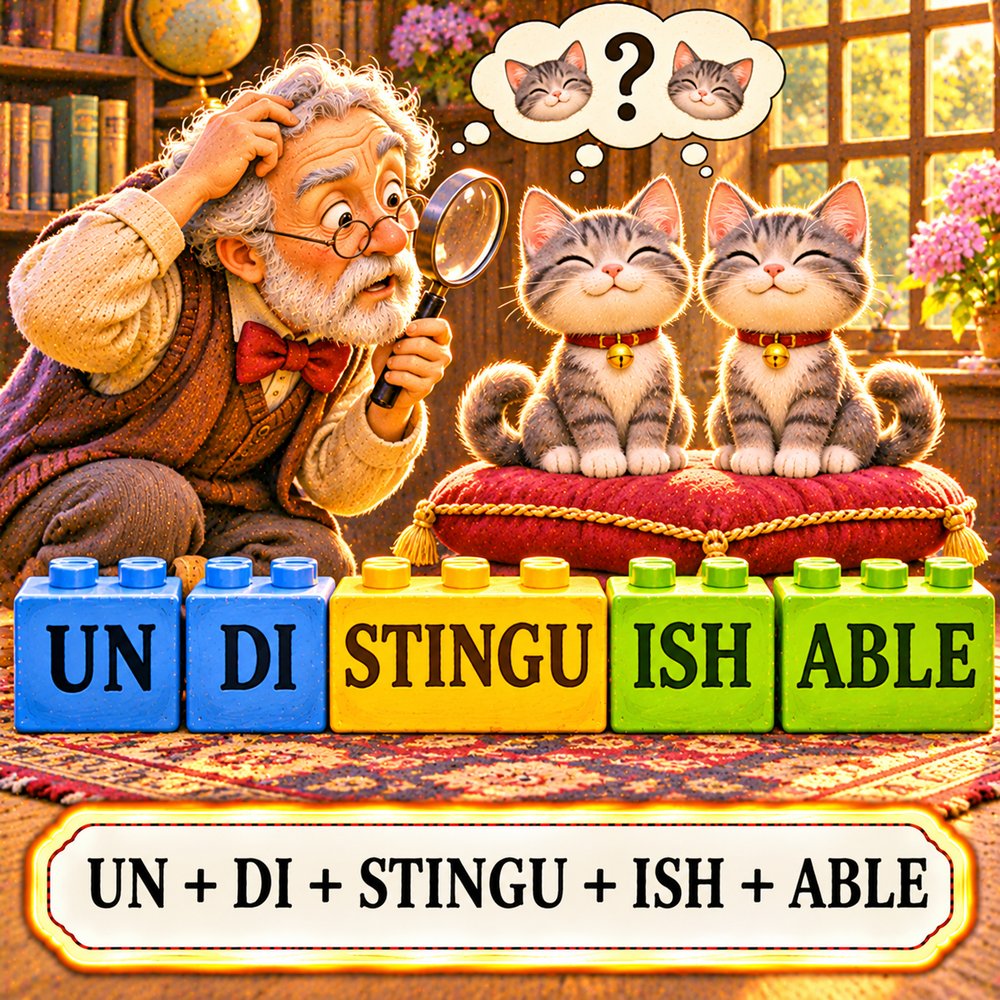
Built layer by layer
A hybrid: an Old English un- on a Latin word. The all-Latin form, indistinguishable, is more common. Both are correct.
disenfranchisement

Built layer by layer
The prefixes work like switches: en- turns the right on, dis- turns it off again.
maladministration

Built layer by layer
Hidden gem: minister (from minus, less) is the opposite of master (from magis, more, PIE *meǵh₂- “great”, Sanskrit महा). A minister served; a master ruled.
oversimplification

Built layer by layer
Three PIE roots and an Old English prefix in one word.
compartmentalizing

Built layer by layer
Each suffix switches the word class: noun → noun → adjective → verb → -ing form. Four languages in one word: Latin, French, Greek and English.
Build it yourself
Tap the pieces in the right order to build the word.
Word histories from the Online Etymology Dictionary, Watkins’ American Heritage Dictionary of Indo-European Roots and the Oxford English Dictionary.